Beyond Narration: Theresia Zhang Paints the Space Between Stories
For New York-based Chinese painter Theresia Zhang, painting is not about illustrating stories — it is about allowing them to continue.
Working between literature, theater and painting, Zhang creates narrative images that capture moments suspended between memory and imagination. Her paintings rarely present complete narratives. Instead, they invite viewers into emotionally charged spaces where figures linger near windows, sit in quiet interiors, or remain caught in moments of psychological tension.
"Sometimes a novel, a line of text, or even a historical image stays with you for years," Zhang said. "I'm interested in understanding why certain moments continue to move us long after we've forgotten the story itself."
Born in Beijing in 2000, Zhang is currently based in New York. She received her BFA in Illustration from the Maryland Institute College of Art before earning her MFA in Painting from the New York Academy of Art in 2025. She also participated in The Metropolitan Museum of Art's Copyist Program, where she spent months studying historical paintings firsthand.
Her work has been exhibited in New York, Shanghai and Baltimore, including exhibitions at LATITUDE Gallery, VillageOneArt, Powerhouse Arts, Tribeca Ball, Warnes Contemporary Gallery, Tappeto Volante Gallery and Rohmer Gallery. Her paintings have also been featured by CBS News, WMAR2 and other international media outlets.
Although Zhang's paintings often reference European literature, classical mythology and nineteenth-century narrative painting, her perspective remains distinctly contemporary.
She describes this approach as "Reversed Chinoiserie."
"Historically, Chinoiserie reflected how Europe imagined China," Zhang explained. "I'm interested in doing the opposite: not by directly portraying art history in the west or the east, but by entering it from a contemporary Chinese perspective."
Rather than treating European visual traditions as distant historical references, Zhang regards them as living materials that can be revisited through migration, personal memory and cross-cultural experience. Classical mythology, medieval manuscripts, opera staging and literary narration become part of a visual language that speaks across cultures rather than belonging exclusively to one.
Her paintings are also deeply shaped by the physical process of making them.
Although every work begins with written notes and small compositional sketches, Zhang intentionally leaves much of the painting unresolved until she begins working directly on the canvas. Layers of oil and acrylic interact unpredictably, creating colors, edges and forms that cannot be fully planned beforehand. For Zhang, the physical interaction of pigments, the way colors merge, resist and transform one another, is inseparable from the meaning of painting itself. Rather than simply applying color to an image, she sees painting as an ongoing dialogue with the material, where each unexpected shift opens new emotional and narrative possibilities.
"I often feel like I'm searching for clues while painting," she said. "A new color relationship or an unexpected shape can completely change where the painting is going."
She compares the process to writing fiction. While a novelist may know the overall structure of a story, new details emerge naturally during the act of writing. Likewise, Zhang believes a painting should continue discovering itself through the behavior of paint rather than simply executing an original plan.
"The material has its own intelligence," she said. "Some colors exist only because they physically encounter one another on the canvas. Those moments of discovery are impossible to predict, and they become part of the painting's meaning."
Painting, for Zhang, also becomes a form of performance. She often imagines herself simultaneously directing and inhabiting the emotional world of the painting, adjusting the relationships between light, gesture, silence and space until the atmosphere feels emotionally convincing.
Alongside her studio practice, Zhang has also worked extensively on public cultural projects. Since 2022, she has created annual zodiac-themed illustrations for Smithsonian Lunar New Year programs in Washington, DC, producing interactive coloring activities for museum visitors and children. Drawing on Chinese idioms, historical imagery and everyday cultural experiences, these works introduce traditional culture through participation rather than explanation.
Whether working on large-scale oil paintings or museum education projects, Zhang continues to explore how images can communicate emotions across languages and cultures.
"Stories belong to different places and different histories," she said. "But emotions travel much farther than language. That's what painting allows me to explore."
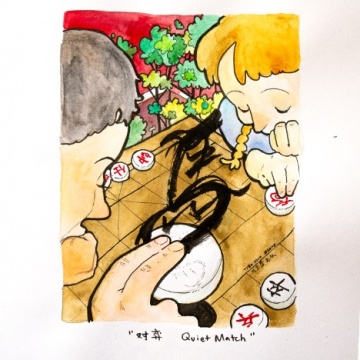
Smithsonian Zodiac Horse
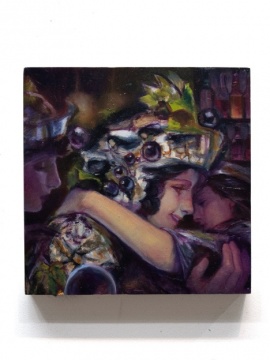
Dionysus 狄俄尼索斯 2026 木板油画 10.2 x 10.2 cm
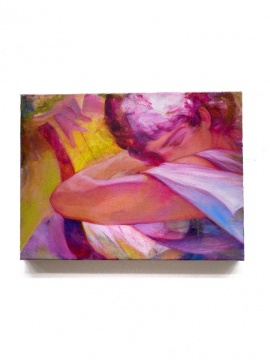
Joy of Music (Orpheus II) 音乐的快乐(俄耳浦斯·二) 2026 布面油画 30.5 x 40.6 cm
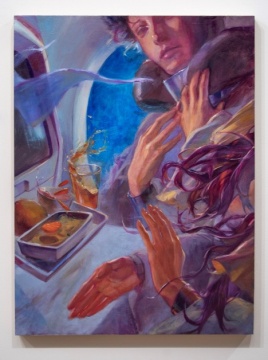
Flying Metal Capsule 飞翔的金属胶囊 2025 木板油画 61 x 45.7 cm
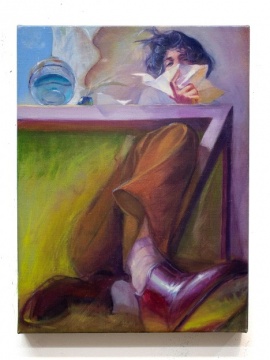
Love Letter 情书 2026 亚麻布面油画 30.5 x 22.9 cm
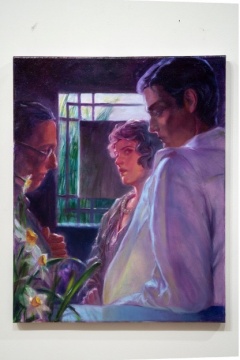
Where His Eyes Rest 他的目光所及之处 2026 亚麻布面油画 50.8 x 40.6 cm
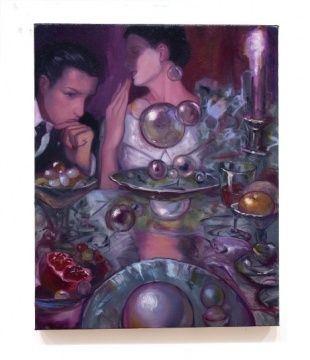
A String of Beads 一串珍珠项链 2026 亚麻布面油画 50.8 x 40.6 cm
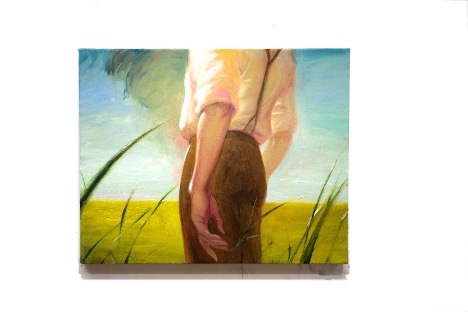
Crash 坠机 2026 亚麻布面油画 40.6 x 50.8 cm
 微信号:hiartmimi
(可享会员福利)
微信号:hiartmimi
(可享会员福利)